Finding a good rental in New Jersey moves fast — and that speed is exactly what scammers count on.
Listings disappear in days. Landlords want applications quickly. And in that rush, it is easy to skip the verification steps that separate a legitimate rental from a situation that costs you money, time, or worse.
This page gives New Jersey renters the tools and information to search more confidently: how to spot scams before they catch you, what to expect at lease signing, how to know if you qualify before you apply, and what your rights are as a tenant in New Jersey.
If you want help working with a licensed REALTOR® who vets properties before you ever see them — that option is here too.
NJ Renter Resources — How to Find a Safe, Legitimate Rental in New Jersey
Avoid Scams. Understand Your Costs. Search Smarter.
Smart Rental Planning
Rental scams are not rare. They appear on Zillow, Apartments.com, Craigslist, and Facebook Marketplace — often using real photos of real properties that are not actually available. The goal is to collect a deposit, application fee, or personal information from someone who never sees the apartment.
How to Avoid Rental Scams In New Jersey
What to Watch For Before You Send Any Money or Personal Information
Watch out for these red flags:
● You are pressured to act immediately or told "someone else is interested"
● The asking price is noticeably below comparable rentals in the area (if it looks 'too good to be true', it probably is.)
● The landlord or agent refuses to show you the property in person
● You are asked to pay by wire transfer, gift card, cash, or payment apps before verifying anything
● The person asks for sensitive personal information before a proper application process
● No lease review, no verification of ownership, no documentation
● A "virtual showing" is offered as a substitute for seeing the property in person — this is not sufficient
The simplest protection: Never send money or personal information to anyone you have not verified, for a property you have not seen in person with confirmed access.
How a REALTOR® Protects You During a Rental Search
Working with a licensed New Jersey REALTOR® is not just convenient — it is one of the most effective ways to avoid the situations above.
What a REALTOR® does that protects you:
● Verifies listings — confirms ownership, landlord identity, and that the unit is legally available
● Confirms legality — illegal apartments (unpermitted basement units, non-code conversions) can be dangerous and can leave you without housing if the issue is discovered after move-in
● Prepares your application — gathers required documents and submits your application competitively
● Attends showings with you — and can identify red flags you might overlook when focused on whether you like the space
● Negotiates on your behalf — terms, move-in dates, fees, and conditions that matter
● Guides you through the lease — so you understand what you are signing before you sign it
The simplest protection: Never send money or personal information to anyone you have not verified, for a property you have not seen in person with confirmed access.
What it costs: In New Jersey, the REALTOR® fee is typically one month's rent, split between your agent and the landlord's agent. In some cases the landlord covers the fee — particularly for units that have been on the market longer. Agents are paid only when they successfully place you in a rental.
Before you start touring, know what you will need at lease signing. Most renters are surprised by how much cash is required upfront.
Standard costs at lease signing:
● First month's rent — paid at signing, covers your first month of occupancy
● Security deposit — New Jersey law caps this at 1.5 months' rent. This is your money, held by the landlord and returned at the end of the lease assuming the unit is left in good condition
● REALTOR® fee — typically one month's rent, paid at lease signing (sometimes covered by the landlord)
● Example: If your rent is $2,000/month — you may need $2,000 (first month) + $3,000 (security deposit) + $2,000 (REALTOR® fee) = $7,000 at lease signing.
Use the lease signing calculator to run your own numbers before you start your search.
Understanding Your Upfront Rental Costs in New Jersey
Rental Tools and Calculators
Use these tools to estimate affordability, check whether you meet a landlord's income requirements, and calculate exactly how much you will need at lease signing — before you apply for anything.
Tool links:
● Rent affordability calculator
Enter your yearly income and target percentage to see the monthly rent you can reasonably afford
● Landlord Income Requirement Calculator
Enter a rent amount and the landlord's required income multiple to see whether your income qualifies
● Lease-signing cost calculator
Enter your monthly rent to see exactly how much you will likely need at lease signing for security deposit, first month, and REALTOR® fee
New Jersey Renter Resources — Official Documents
These state and federal resources help you understand your rights and responsibilities as a tenant in New Jersey.
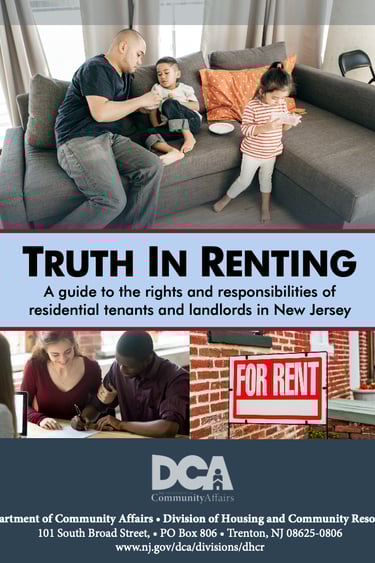
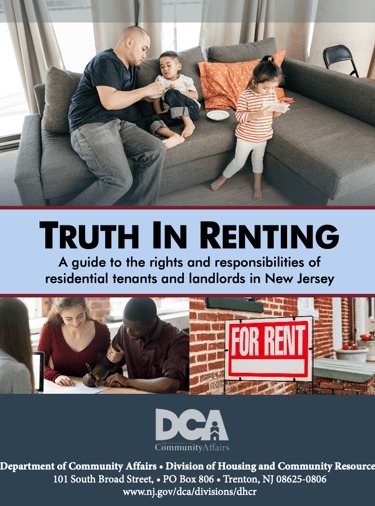
Click above to download the Truth in Renting book from the New Jersey Department of Community Affairs.
The official guide to the rights and responsibilities of residential tenants and landlords in New Jersey. Covers leases, rent, security deposits, habitability, and eviction-related information.


Click above to download the
Protect Your Family from Lead in Your Home
Required reading for renters in older New Jersey buildings. Covers lead paint risks, disclosure requirements, and what to ask before signing a lease.
Click above to obtain you Free Credit Report and your Free Credit Score
Knowing your credit standing before you apply is one of the simplest ways to avoid surprises during a landlord's screening process.
If you have a timeline, a budget range, and basic documentation in order, fill out the rental intake form. It takes about two minutes and gives me the information I need to help you search more efficiently — and avoid wasting time on properties that are not a realistic fit.
Ready to Start Your Rental Search in New Jersey?
Many New Jersey renters are also thinking about buying — whether that is one year away or five. The NJ Home Buyer's Book is a free resource that walks through the entire home buying process step by step, specifically for New Jersey buyers.
Renting Now, Buying Later?
Rent as a percentage of income
Many clients have a hard time figuring out how much they can afford for monthly rent. Everyone's financial situation is different, and we understand that, but use these calculators as a rough guideline to help you.
The generally accepted 'standard' of how much you can afford for rent is approximately 30% of your income. Savings, debt, and other expenses could impact the amount you want to spend on rent each month.
This calculator will calculate an estimate rent you can afford when you enter your yearly income, and then what percentage of that income you would want to put towards rent.
Try it out!
Use the Rental Tools Before You Apply
Estimate affordability, income requirements, and move-in costs so you can search more realistically and avoid surprises.


Income as a multiple of rent calculator
This calculator will tell you how much you need to make if the landlord wants their tenants to make a multiple of their rent.
Sometimes the landlord has a stipulation that they want the tenants income to be a certain multiple of rent. This will help you calculate that.
Try it out!
How much do you need at lease signing?
This is probably the most important calculator. This one will tell you how much you will need at lease signing. Usually you will need bank checks or money orders for 1.5 month's security deposit, your first month's rent, and one month's rent to cover the REALTOR fee. (Sometimes the REALTOR fee is covered by the landlord, but that is a rare occasion)
Try it out!
Can I get scammed when looking for a rental in New Jersey?
Yes. Rental scams are common across all major listing platforms including Zillow, Craigslist, and Facebook Marketplace. Red flags include pressure to pay quickly, requests for unusual payment methods, refusal to show the property in person, prices that seem too low for the area, and requests for personal information before a proper application. Never send money or sensitive documents to anyone you have not verified.
How much money do I need at lease signing in New Jersey?
Most renters need first month's rent, a security deposit of up to 1.5 months' rent, and in many cases a REALTOR® fee equal to one month's rent. Use the lease signing calculator on this page to estimate the exact amount based on your specific rental price.
What is the maximum security deposit a landlord can charge in New Jersey?
Under New Jersey law, a landlord cannot charge more than 1.5 months' rent as a security deposit. This money must be held in a separate bank account and returned to you at the end of your lease, minus any legitimate deductions for damage beyond normal wear and tear.
Why do landlords ask for income multiples like 2.5x or 3x the rent?
Landlords use income multiples as part of their tenant screening process to evaluate whether an applicant is financially able to handle the rent consistently. A common standard is 2.5 to 3 times the monthly rent as gross monthly income. If rent is $2,000/month, a landlord may want to see income of $5,000 to $6,000 per month. Use the income requirement calculator on this page to check your numbers before applying.
Should I check my credit before applying for a rental?
Yes — always. Most landlords review credit as part of the application process. Checking your own credit in advance lets you identify and address any issues, understand where you stand, and avoid being caught off guard during screening. You can get your free credit report at annualcreditreport.com and your free credit score at creditkarma.com.
Do I need a REALTOR® to rent an apartment in New Jersey?
You are not required to use one. However, working with a licensed agent gives you access to verified listings, professional screening of properties and landlords, guidance through the application and lease process, and protection against the scams that are common when searching independently. Agents work on commission — they are paid only when they successfully place you in a rental.
What is an illegal apartment and how do I avoid renting one?
An illegal apartment is a unit that does not have proper permits or does not meet local housing codes — often unpermitted basement conversions or additional units added without approval. Renting one can be dangerous due to inadequate fire safety or ventilation, and can leave you without housing if the unit is ordered vacated. A licensed REALTOR® can help verify whether a unit is legally rented before you sign anything.
What is the Truth in Renting publication in New Jersey?
The Truth in Renting publication is issued by the New Jersey Department of Community Affairs and is the official guide to the rights and responsibilities of residential tenants and landlords in New Jersey. It covers leases, rent increases, security deposits, habitability standards, landlord entry rights, and eviction procedures. It is available as a free download on this page.
Frequently Asked Questions About Renting in New Jersey
Whether you are looking for a rental or not, it's always good to keep tabs on your Credit Report. You can get yours for free here:
Knowing, and keeping tabs on your Credit Score is also important. You can get yours for free here:
This page is for informational and educational purposes only. Patrick Rumore is a licensed New Jersey REALTOR®, not an attorney. Rental laws, fees, security deposit rules, and landlord requirements vary by municipality and individual property. Always review any lease with qualified legal counsel before signing.
Required NJ Fair Housing Disclaimer Components:
Protected Classes: Discrimination is illegal based on race, creed, color, national origin, sex, gender identity or expression, marital/civil union/domestic partner status, affectional or sexual orientation, familial status, pregnancy or breastfeeding, disability, ancestry, liability for service in the Armed Forces, or source of lawful income.
Source of Income/Subsidy: It is illegal to state "No Section 8" or refuse to accept rental vouchers.
Criminal Records (Fair Chance in Housing Act): Landlords generally cannot ask about criminal history until after a conditional offer is made, and cannot consider arrests or sealed records.
"We are an equal opportunity housing provider. We do not discriminate on the basis of race, color, religion, sex, national origin, disability, familial status, or any other characteristic protected by NJ Law Against Discrimination, including source of lawful income and sexual orientation."
We are pledged to the letter and spirit of New Jersey's policy for the achievement of equal housing opportunity throughout the State.
Have a question about renting in New Jersey?
Send Patrick a message — whether you are just starting your search, have a question about a specific property, or want a second opinion before signing a lease.
Get in touch
Address
17-10 River Rd.
Suite 3C
Fair Lawn, NJ 07410